

The Viral Illusion: Why the Internet Gets Humanoid Robotics Wrong


They seem to be everywhere online: very realistic human-like, human-scale robots with smooth surfaces, proper proportions, fast and natural movement, able to do almost anything a human can do. They seem friendly, make jokes, and often show off physical feats only gymnasts can do. Millions of people watch these videos, and the comments often say, “The future’s already here!” Yet the reality in early 2026 is far more complex than these videos suggest.
By “illusion,” the issue is not whether these demonstrations are impressive or irrelevant. It is that viral representations increasingly blur the line between what is rendered, what is staged, and what is deployable. Social media collapses CGI characters, AI-augmented performers, and early-stage robotic systems into a single narrative that does not reflect how humanoid robots actually function, or where they can realistically operate today.
Many widely shared clips do not show autonomous humanoid robots at all. Others involve real hardware, but in highly controlled conditions, with errors, retries, and human intervention edited out. Together, these portrayals create an idealized vision optimized to gain engagement and views rather than represent actual accuracy, one that diverges from how humanoid systems are developed, tested, and deployed in practice.
Real progress is happening, just not in flashy settings. It is taking place in research labs, schools, factories, and warehouses where robots are tested and refined on specific, practical tasks. In these places, being reliable and useful is far more important than looking human or impressive on camera.
Real Humanoids Robots
RobotShop operates on the opposite end of the spectrum: real hardware, real constraints, and real deployment paths. The focus is not on spectacle, but on identifying platforms that can be evaluated, integrated, and used in real environments.
View Humanoid Robotics PlatformsThe Rise of the “Instagram Android”
The gap between viral humanoid imagery and real-world robotics has widened, not because progress has slowed, but because representation has accelerated.
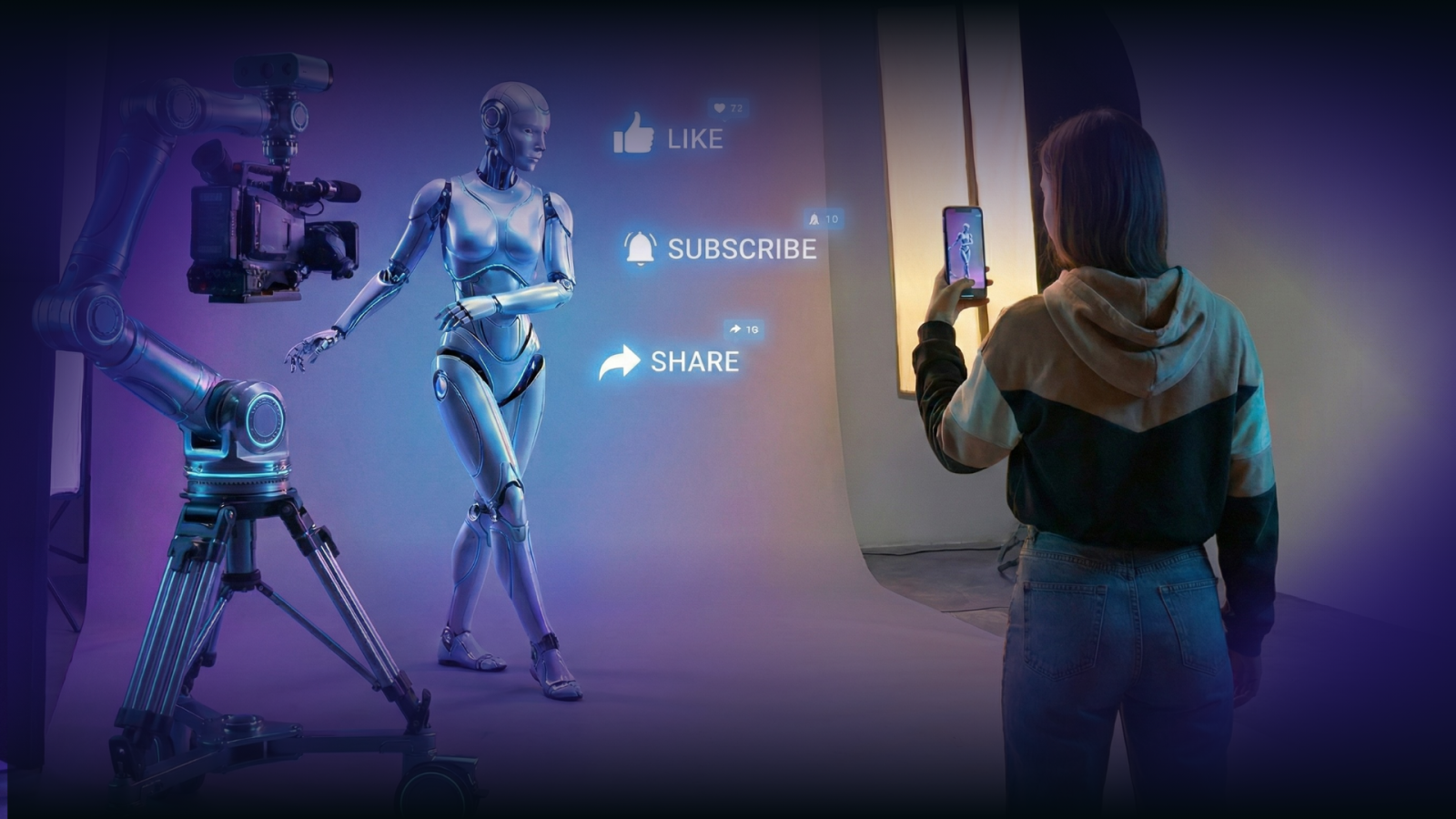
Highly produced videos depict humanoid figures performing fluid, socially complex behaviors in everyday settings. Many rely on CGI, digital doubles, or AI-augmented performers. They appear plausible, but they do not reflect autonomous physical systems operating under real-world constraints.
At the same time, real progress is unfolding quietly in constrained environments, logistics workflows, industrial inspection, research labs, where reliability matters more than appearance.
Why Illusions Go Viral (and Real Robots Far Less Often)
The incentives are economic, not technological.
Synthetic humanoids are inexpensive to produce, infinitely scalable, and unconstrained by physics, safety certification, power budgets, or mechanical failure. They only need to perform well on camera.
Real robots, by contrast, must be built, tested, integrated, and allowed to fail in the real world conditions. While recent advances in hardware and AI have accelerated progress, achieving reliable, general-purpose functionality remains constrained by physical interaction, perception, and control.
Social platforms reward attention, not accuracy. As a result, highly produced or synthetic demonstrations tend to receive disproportionate visibility, while real engineering progress often unfolds more quietly.
The Real Cost of Fake Narratives
The damage is not abstract.
When real humanoid systems exhibit limited dexterity, constrained autonomy, or mechanical motion, they are often perceived as “behind,” rather than approaching usability thresholds. Repeated exposure to exaggerated demonstrations erodes trust, making genuine progress appear underwhelming by comparison.
It delays recognition when innovation becomes real.
The Bottom Line
Humanoid robotics is not distant. It is approaching deployment thresholds faster than popular narratives suggest, just not in cinematic form, or in the exaggerated scenarios that capture attention online.
The risk today is not over-optimism. It is mistaking spectacle for signal, and narrative lag for technological delay. Organizations that learn to recognize reality early will be best positioned when humanoid systems quietly cross from impressive demonstrations into useful tools.
Real Avatar Robotics: The State of Humanoids in 2026
Thanks for helping to keep our community civil!
This post is an advertisement, or vandalism. It is not useful or relevant to the current topic.
You flagged this as spam. Undo flag.Flag Post
Your post is currently under review by our moderation team. The review process usually takes up to 48 business hours.
You can track your post's status in the "My Content" section of your profile. Once approved, it will be published and visible to others.

Thank you for contributing to our community!